
Octopus Agile Battery Storage: Why Smart Tariffs Only Work Properly With Automation
The promise of cheap electricity is real, but catching it is harder than it looks
Octopus Agile is one of the most talked-about energy tariffs in the UK right now, and for good reason. Prices update every 30 minutes, tracking wholesale electricity costs in near real time. When the grid is flush with renewable energy, rates can drop to almost nothing, or occasionally go negative, meaning you get paid to use electricity. When demand spikes, prices rise accordingly.
On paper, it sounds like a straightforward win. Charge your battery when prices are low, use that stored energy when prices are high, and watch your bills shrink. In practice, though, most households find the reality a little more complicated.
The problem is not the tariff. The problem is timing.
---
Why manual management falls apart
To genuinely benefit from Octopus Agile battery storage, you need to be making the right decisions at the right time, every single day. That means checking 30-minute price slots, working out when your battery should charge, deciding whether your EV needs to top up overnight, figuring out if your hot water cylinder should run now or later, and coordinating all of it around your actual energy use.
Most people try this manually for a few days and then give up. Life gets in the way. You forget to check the prices before bed. You charge the battery at the wrong time. Your heat pump runs at peak rate because nobody told it not to.
The tariff is doing its job. The home is not keeping up.
This is exactly why Octopus Agile battery storage only delivers its full potential when it is paired with intelligent automation. The tariff creates the opportunity. Automation captures it.
---
What automation actually does differently
A smart Home Energy Management System, or HEMS, connects to the Octopus Agile price feed and makes decisions automatically based on real-time data. It knows what electricity will cost in each half-hour slot ahead of time, and it uses that information to schedule your devices accordingly.
When tomorrow's overnight prices look favourable, the HEMS charges your battery during the cheapest window. When a solar generation forecast suggests you will produce enough energy in the afternoon, it holds back on charging from the grid. When your heat pump needs to run a cycle, it schedules that task for a low-cost slot rather than defaulting to whenever the thermostat demands it.
This is the difference between having a smart tariff and actually using a smart tariff.
Most energy systems focus on optimising individual devices. A battery charges and discharges. An EV charger charges a car. A heat pump heats a home. Each component may be operating efficiently in isolation, but that does not necessarily mean the home is operating efficiently as a whole.
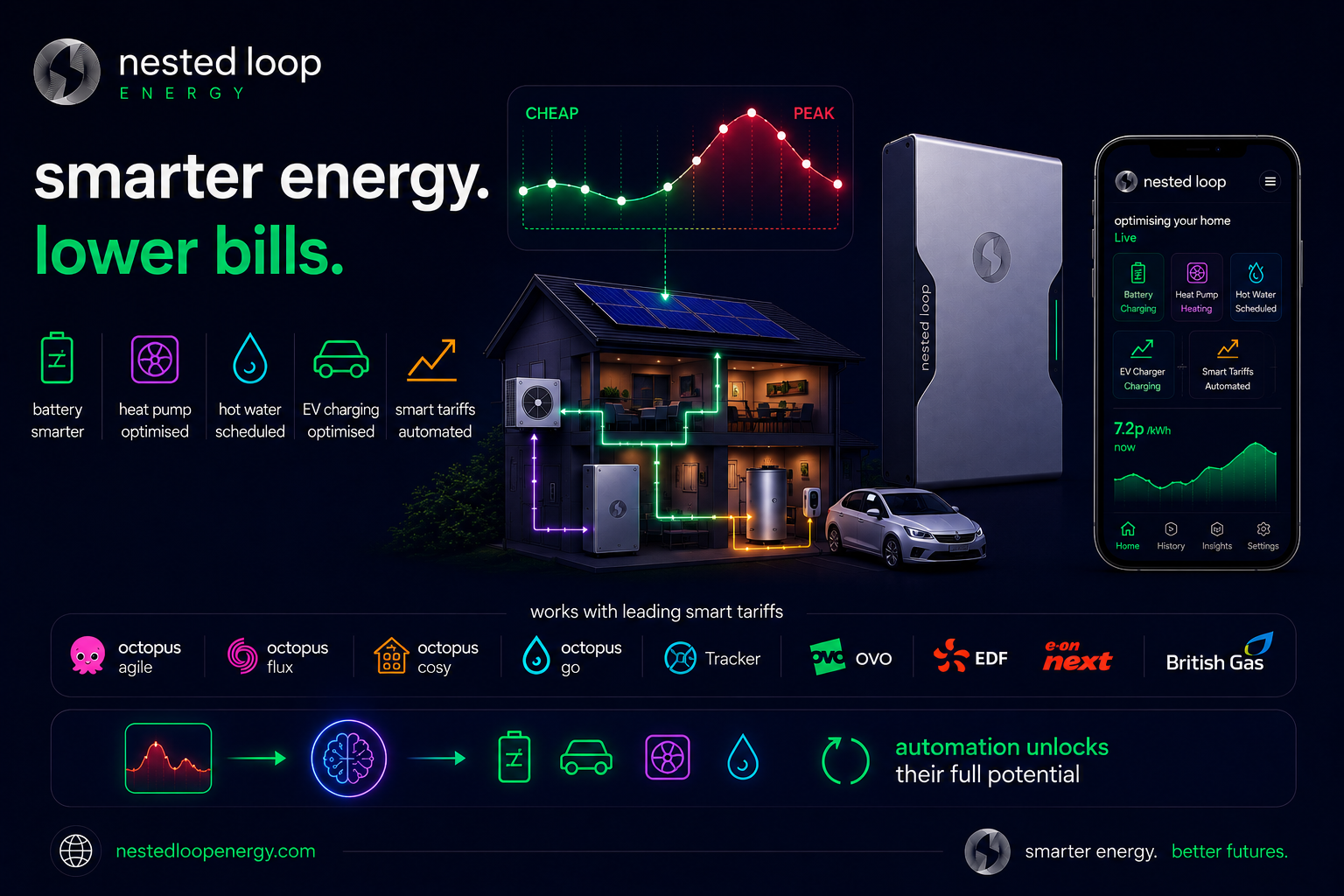
nested loop takes a different approach. Rather than optimising individual devices, it is designed to optimise the entire home energy system. By coordinating batteries, solar panels, EV chargers, heat pumps, hot water systems and other controllable loads together, nested loop can make decisions based on what delivers the best overall outcome for the household, not just the best outcome for a single device.
nested loop is built around exactly this kind of whole-home intelligence. The HEMS coordinates your battery, solar panels, heat pump, EV charger and hot water cylinder simultaneously, all through one app, responding to live Octopus Agile pricing without you needing to lift a finger. There is no rip and replace involved either. nested loop works with existing home setups, which makes it practical for the vast majority of households and housing providers rather than just those starting from scratch.
---
A real-world example
Consider a household with solar panels, a heat pump, an EV and a battery. On a typical winter day, the Agile rates drop sharply between midnight and 5am. Without automation, the battery might charge at a random point in the evening, the EV might be plugged in and drawing power at 7pm when rates are elevated, and the heat pump will simply respond to the thermostat whenever it calls for heat.
With a HEMS connected to the Octopus Agile price feed, the picture changes completely. The battery charges in the cheapest overnight window. The EV charges after midnight when prices are low. The heat pump pre-heats the home just before the cheap window closes, reducing how much it needs to run during the expensive morning peak. Any solar generation during the day tops up the battery before the evening peak hits.
The tariff has not changed. The home has simply learned how to use it properly.
Over a month, these automated micro-decisions add up to a meaningful reduction in bills. Over a year, the impact is substantial.
---
The bottom line
Octopus Agile battery storage is a genuinely powerful combination, but only when the two halves are actually talking to each other. A battery sitting in your garage without intelligent scheduling is just a box. A smart tariff without automation is just a price signal that nobody is acting on.
The households and housing providers seeing the best results are those where the whole home is coordinated, not just the battery. Every device optimised together, every cheap rate captured automatically, every peak avoided without the resident needing to think about it.
If you are exploring how to make Octopus Agile work harder in your home or across a housing portfolio, it is worth thinking about the control layer, not just the hardware. Take a look at nestedloopenergy.com to see how whole-home coordination changes the equation.