
EXPLAINER
Solar panels vs solar + battery: what actually saves more?
Solar Panels With Battery Storage UK: What Actually Saves More?
If you've had solar panels for a while, you've probably noticed the frustration. The sun comes out, your panels generate more electricity than you can use, and most of that surplus disappears into the grid for a fraction of what you pay to import power. It feels like leaving money on the table, because it is.
The question most homeowners are now asking is whether adding a battery changes that equation significantly, or whether the upfront cost makes it hard to justify. The honest answer is: it depends on how your household uses energy, and increasingly, on how smart your system is.
What Solar Alone Actually Does For Your Bills
Solar panels are genuinely effective at reducing daytime electricity consumption. On a sunny day, a typical 4kWp system can generate enough to cover most of a household's daytime demand, which cuts your import from the grid and your bills along with it.
The problem is timing. Peak generation happens between roughly 10am and 3pm. Peak household demand tends to happen in the morning and evening. Without storage, you're exporting cheap electricity and buying expensive electricity back a few hours later. The Smart Export Guarantee helps, but export rates are still well below import rates for most tariffs.
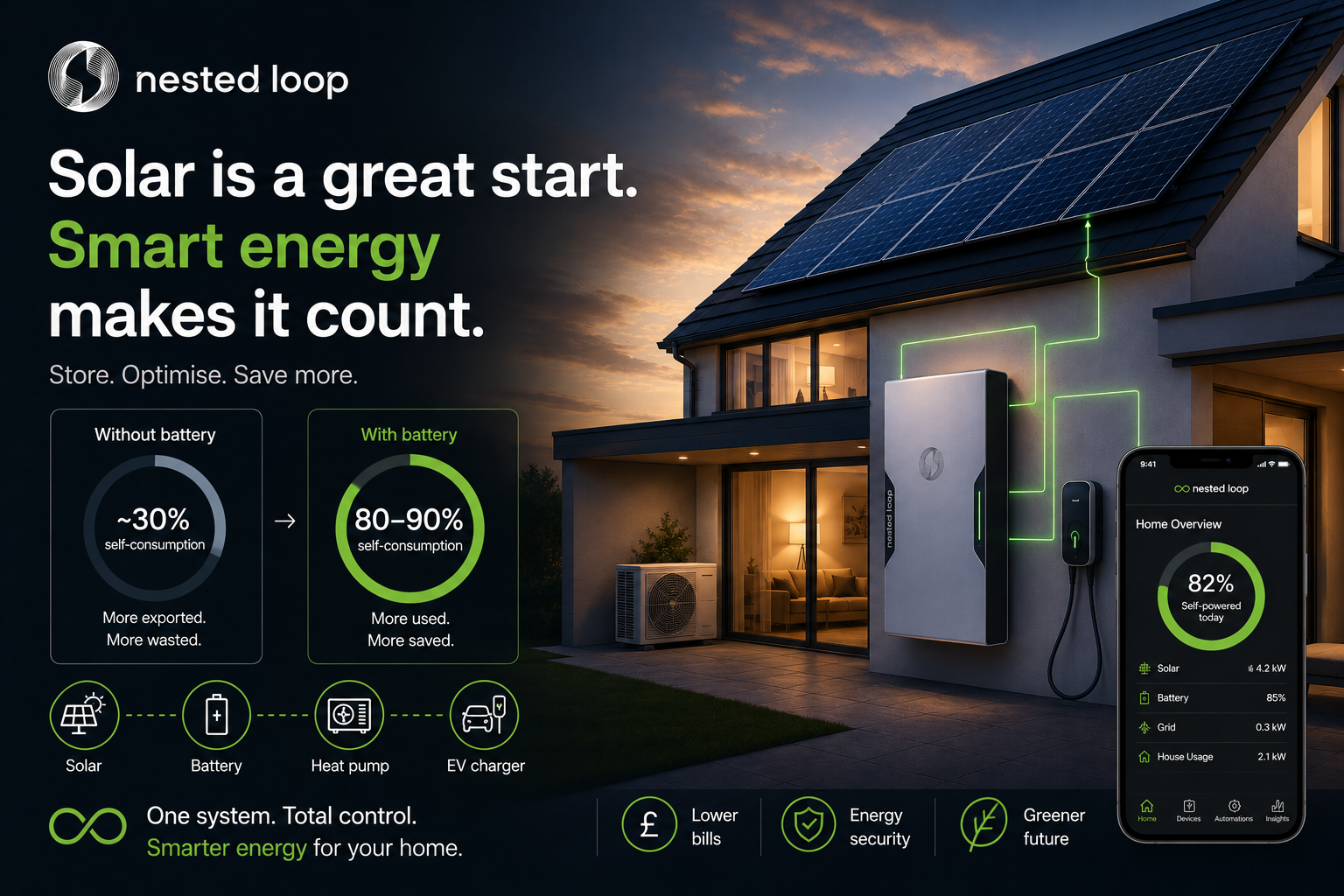
For homeowners who are out during the day, solar-only systems can feel underwhelming. Self-consumption rates without storage typically sit between 25% and 40% for an average working household.
How Battery Storage Changes the Maths
Adding a battery to your solar setup fundamentally changes what you can do with the electricity you generate. Instead of exporting surplus energy at low rates, you store it and use it when you actually need it, typically in the evening or overnight.
This can push self-consumption rates up to 70% to 90% depending on household size, battery capacity, and usage patterns. For a household paying 24p per unit to import electricity, keeping more of your own generation means real, measurable savings.
The payback calculation for solar panels with battery storage UK-wide varies, but most well-specified systems are now returning payback periods of 7 to 10 years, with battery prices having dropped substantially over the past few years.
There's also the tariff angle. Smart time-of-use tariffs like Octopus Agile or Intelligent Octopus allow households with batteries to charge from the grid during cheap overnight periods, even when solar generation is low. This adds another layer of savings on top of what solar alone can deliver.
Solar Plus Battery Plus Smart Control: Where the Real Gains Are
This is where the conversation gets more interesting. A battery stores energy. But a battery combined with intelligent home energy management does significantly more.
Consider a home with solar panels, a battery, a heat pump, and an EV charger. Without coordination, each device operates independently. The EV might charge at peak rate. The heat pump might run when solar generation is low. The battery might fill up early and miss a better charging window overnight.
With a smart HEMS platform, all of those assets are optimised simultaneously. The system looks at solar forecast data, energy tariff pricing, household demand patterns, and grid signals, then makes real-time decisions across every device. That's how you get from decent savings to genuinely optimised energy costs.
This is exactly what nested loop is built for. Rather than treating the battery as a standalone product, nested loop acts as the intelligent control layer across the whole home, coordinating solar, battery, heat pump, EV charger, and hot water cylinder through one platform and one app. It works with existing home setups too, so there's no need to rip out what's already installed.
A Real-World Example
Take a semi-detached home in the Midlands: four occupants, a 4kWp solar array, an air source heat pump, and an EV. Before adding a battery and HEMS, their solar self-consumption was around 30% and their energy bills were still substantial.
After installing battery storage with intelligent coordination, self-consumption rose to around 80%. The heat pump scheduling shifted to align with peak solar generation. The EV charged overnight on a cheap tariff rather than randomly through the day. Their annual energy costs dropped by roughly 40%.
The battery alone would have helped. The battery plus smart coordination is what made the difference.
So, Solar or Solar Plus Battery?
For most UK households, solar panels with battery storage deliver meaningfully better returns than solar alone, particularly as import tariffs remain high and smart tariffs become more accessible.
The gap widens further when you factor in intelligent home energy management. A battery that just stores energy is a good start. A system that optimises every asset in your home simultaneously, adapting to tariffs, forecasts, and your actual usage patterns, is where the real value sits.
If you're weighing up whether to add storage to an existing system, or thinking about a full setup from scratch, it's worth exploring how your specific home assets could be coordinated, not just what size battery you need.
You can find out more about intelligent home energy management at nestedloopenergy.com.