
EXPLAINER
Home Battery Storage UK: Why More Households Are Using Batteries to Fight Rising Energy Bills
Energy bills in the UK have become one of the most talked-about household concerns of the past few years. Prices have surged, tariffs have shifted, and millions of people are left wondering whether there is anything they can actually do to take back some control. The answer, increasingly, is yes, and home battery storage is at the centre of that conversation.
What Is Home Battery Storage and Why Is It Having a Moment?
Home battery storage UK installations have grown significantly as more households look for practical ways to reduce what they spend on electricity. In simple terms, a home battery stores electricity so you can use it when it suits you rather than when the grid dictates. Paired with solar panels, a battery captures the energy your panels generate during the day and holds it for the evening, when your home actually needs it most.
But the shift goes beyond solar owners. Smart time-of-use tariffs, like Octopus Agile or Flux, now mean that grid electricity is genuinely cheap at certain hours, sometimes close to zero or even negative. A battery lets you charge during those cheap windows and discharge when prices are high. Without one, you have no way to take advantage of that flexibility.
The Real Maths Behind Energy Bill Savings
The appeal of home battery storage in the UK comes down to one thing: the gap between cheap and expensive electricity is wide enough to make a real difference to your bills.
A typical household with a 5 to 10 kWh battery, a smart tariff, and solar panels can see meaningful reductions in what they pay for electricity year-round. During summer months, solar generation often covers daytime demand entirely, with the battery handling evening loads. In winter, the battery charges overnight on cheap-rate electricity and covers peak evening usage when rates are highest.
This is not a theoretical saving. Households who combine solar, storage, and a smart tariff are routinely cutting their electricity costs by a significant margin compared to those on standard variable tariffs with no flexibility at all.
It Is Not Just About the Battery Anymore
Here is where things get more interesting, and where the conversation about home battery storage UK has evolved considerably.
The battery on its own is a tool. What makes it genuinely powerful is how it fits into the broader picture of your home's energy use. If you also have an EV charger, a heat pump, or a hot water cylinder, each of those devices is either working with your energy strategy or against it. Without intelligent coordination, they pull from the grid at the worst possible times.
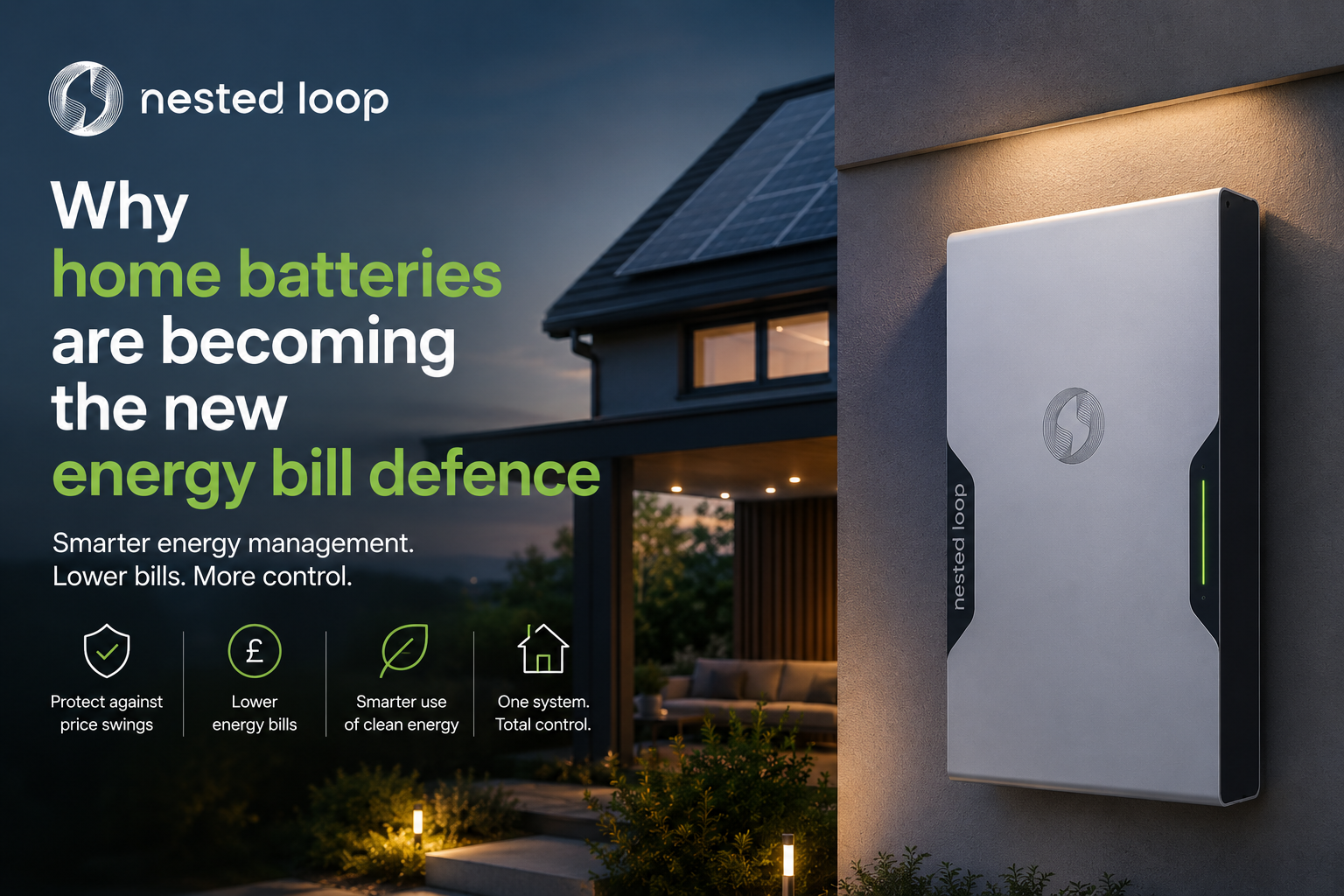
This is exactly the problem that nested loop was built to solve. Rather than treating the battery as a standalone product, nested loop operates as a Home Energy Management System, the intelligent layer that coordinates your battery, solar panels, heat pump, EV charger, and hot water cylinder simultaneously, all through a single app.
The difference is meaningful. A battery-only system stores energy. nested loop decides, in real time, which devices to prioritise, when to charge and discharge, and how to keep costs as low as possible across the whole home, not just one asset. It works with your existing setup too, so there is no need to rip out what you already have.
For housing providers and local councils managing multiple properties, nested loop also offers portfolio-level dashboards, giving visibility and control across an entire estate from one platform.
A Real-World Example: The Evening Peak Problem
Consider a household that gets home at 6pm. The solar panels stopped generating a few hours ago. The EV needs charging. The heat pump is starting its evening cycle. The hot water cylinder is topping up. All of this happens at exactly the moment grid electricity is at its most expensive.
Without storage and intelligent control, every one of those devices draws directly from the grid at peak rates. With home battery storage and a HEMS platform, the battery covers that evening demand, the EV charges during the cheap overnight window, and the hot water cylinder is pre-heated at the lowest-cost point of the day. The result is the same warmth, the same full battery in the car, but at a fraction of the cost.
This is the practical, everyday case for home battery storage in the UK that goes beyond the headline savings figures.
What This Means for Households Right Now
Energy prices may stabilise, fluctuate, or rise again. Nobody can predict that with certainty. What is clear is that households with home battery storage are less exposed to those swings. They have options. They can act on cheap rates, store their own solar generation, and avoid peak pricing in ways that households without storage simply cannot.
The technology has matured, costs have come down, and the tariff landscape has evolved to make storage genuinely worthwhile even without solar. If you are thinking about your energy setup and wondering whether now is the right time to explore home battery storage, the honest answer is that the case has rarely been stronger.
Curious about how a whole-home approach to energy management could work for your property? It might be worth exploring what intelligent coordination actually looks like in practice at nestedloopenergy.com.